
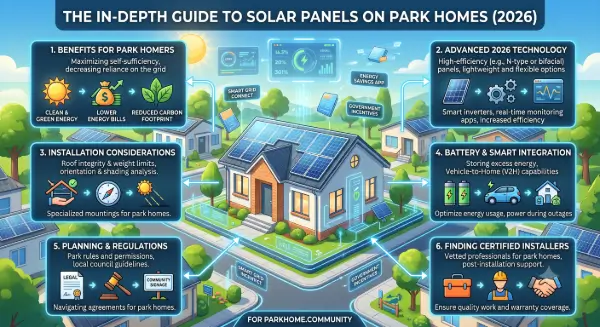
As energy prices continue to fluctuate, park home residents are increasingly looking for ways to cut utility costs and reduce their environmental footprint. While traditional brick-and-mortar homeowners have been adopting solar technology for decades, the residential park home community faces a unique set of challenges and rules.
The short answer is yes, you can install solar panels on a park home. However, because park homes are constructed to BS3632 standard—engineered with lightweight timber frames and chassis—there are crucial structural, legal, and financial factors you must navigate before signing an installation contract.
1. The Realities of Park Home Roof Structures
Weight constraints are the single largest hurdle when retrofitting a static or mobile home with solar technology. Standard domestic roofs are built with heavy trusses designed to hold slate or clay tiles. Park homes use lightweight timber frames covered with felt, lightweight metal tiles, or bonded synthetic coverings.
A standard rigid solar panel weighs roughly 15kg to 20kg. A system of eight panels adds over 150kg to your roof, not including the heavy metal mounting rails. This continuous dead load can cause the roof to bow, stress the chassis, or compromise the weatherproofing.
The Solutions to Weight Constraints:
- Structural Surveys: A qualified structural engineer or specialised park home surveyor must conduct a 'Part A' structural assessment to calculate your roof's load-bearing limits.
- Lightweight Flexible Panels: Many manufacturers now produce thin-film, flexible solar panels. These adhere directly to the roof surface without heavy mounting rails and weigh as little as 3kg to 5kg per panel.
- Ground-Mounted Arrays: If your roof cannot take the weight, and your pitch is large enough, you can install solar panels on a reinforced frame directly on the ground.
The Advantages
- Drastic Bill Reduction: A properly sized system can cut your annual electricity bills by 50% to 70%.
- Energy Independence: Shield yourself from the volatility of national grid price caps.
- Earn Money Back: Via the Smart Export Guarantee (SEG), you can sell unused green energy back to the grid for a profit.
- Tax Relief: You currently pay 0% VAT on the panels and the installation labour until March 2027.
The Disadvantages
- High Initial Outlay: Without grants, a complete 3kW system can cost between £4,000 and £7,000 upfront.
- Site Owner Resistance: You must gain explicit permission, which can be difficult on strictly regulated parks.
- Insurance Complexity: You must inform your home insurer. Because solar panels change the rebuild value and risk profile, your premiums may increase.
2. Navigating Park Rules and Legalities
Unlike a traditional freehold property, owning a park home means you own the structure but lease the land beneath it. This dynamic dramatically changes what you are legally allowed to do.
The Mobile Homes Act 1983 & Pitch Agreements
Your pitch agreement is a legally binding contract. Almost all standard pitch agreements state that residents must obtain written permission from the park owner before making any structural alterations or changing the external appearance of the home.
The law dictates that a park owner cannot unreasonably withhold permission. However, they are entirely within their rights to deny the request if the panels would genuinely damage the visual amenity of the park, pose a glare hazard to neighbours, or compromise safety. Always approach your site manager with a full proposal from a certified installer before purchasing anything.
Planning Permission (Permitted Development)
In most parts of the UK, adding solar panels falls under 'Permitted Development' and does not require a formal planning application. However, you must check with your local authority if your park is located within a Conservation Area, a National Park, or an Area of Outstanding Natural Beauty (AONB), as permitted development rights are often restricted in these zones.
3. Financial Grants and Funding (2026 Updates)
The government offers several avenues of financial support to help park home residents transition to renewable energy.
- The ECO4 Scheme: Running until December 2026, this scheme places a legal obligation on large energy suppliers to fund energy efficiency upgrades. Your household must earn £31,000 or less, or receive qualifying means-tested benefits. Because park homes often have lower EPC ratings (D, E, F, or G), they are prime candidates for full funding.
- Warm Homes: Local Grant: Rolled out by local authorities, this grant offers up to £15,000 for energy upgrades. It is aimed at households with an income below £36,000.
- 0% VAT: The government has extended the 0% VAT rate on the installation of energy-saving materials until March 2027. This applies automatically to your installer's invoice.
4. Connecting to the Grid and Getting Paid
If your panels generate more electricity than you can use (which often happens on sunny summer afternoons), you don't have to let it go to waste.
The Smart Export Guarantee (SEG) mandates that large energy suppliers pay you for the renewable energy you export back to the National Grid. To qualify, your solar installation must be certified by the Microgeneration Certification Scheme (MCS), and your park home must be fitted with a smart meter capable of taking half-hourly readings.
Export rates vary wildly between suppliers, typically ranging from 4p to 15p per kWh. It is highly recommended to shop around and switch your energy supplier to find the most competitive SEG tariff once your panels are live.
Conclusion
Adding solar panels to your park home is entirely possible and highly beneficial, provided you take the correct steps. Prioritise a structural survey, communicate openly with your site owner to secure written permission, and thoroughly explore the available government grants. With the right lightweight system, you can significantly reduce your reliance on the grid and protect yourself against future energy price hikes.