
Demystifying Park Home Plumbing: Maintenance, Winterisation, and Avoiding Leaks
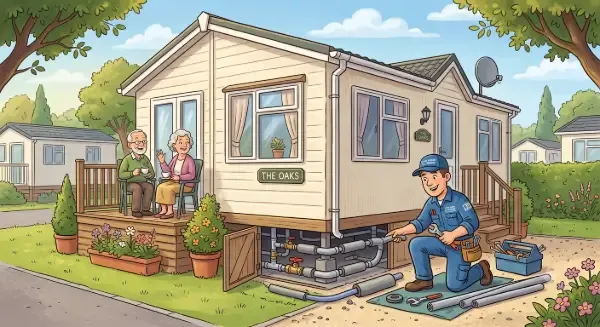
If you have recently moved from a traditional brick-and-mortar property into a park home, you might assume the plumbing is exactly the same. After all, water comes out of the taps and goes down the plughole just like anywhere else!
However, the way a park home is constructed—elevated on a chassis with an exposed cavity underneath—means its plumbing system faces a unique set of challenges. Understanding these quirks is essential for preventing leaks, avoiding freezing pipes, and keeping your water flowing smoothly all year round.
Here is what every park home owner needs to know about their plumbing system.
1. The Cold Reality: Preventing Frozen Pipes
The single biggest issue park home owners face with their plumbing is freezing. In a standard house, pipes are buried deep underground or insulated within thick brick walls. In a park home, your mains water feed and supply pipes are usually routed through the open, draughty space directly beneath your floorboards.
When the UK winter bites, the wind whipping beneath the chassis can freeze uninsulated pipes in a matter of hours, leaving you without water and risking a burst pipe.
How to protect your home:
Lagging (Insulation): Every single water pipe beneath your home must be heavily insulated with high-quality foam lagging. Do not leave any joints or corners exposed.
Trace Heating: This is the gold standard for park homes. A trace heating cable is a low-wattage electrical wire that runs alongside your water pipes beneath the insulation. It operates on a thermostat, automatically warming up when the temperature drops near freezing to ensure the water inside never turns to ice.
Skirting: Ensure your brick or UPVC skirting is in good condition. While it needs vents to allow for airflow (to prevent damp), a solid skirt significantly reduces the wind chill factor underneath the home.
2. Dealing with Water Pressure Fluctuations
Unlike a traditional street where every house taps straight into the local water board's mains, park homes usually share a private water supply managed by the site owner. The main feed comes into the park and is then distributed across the estate.
Because of this, water pressure can fluctuate wildly depending on your proximity to the main pump and how many of your neighbours are using their washing machines or having a shower at the same time!
What you can do:
Pressure Reducing Valves (PRVs): If your pressure is too high, it can put immense strain on your boiler and internal pipework. A PRV can be fitted to your incoming main to regulate the flow.
Boiler Faults: If your boiler frequently drops out when you run the hot tap, it may simply be that the site's water pressure isn't high enough to trigger the boiler's flow switch.
Note: The site owner is generally responsible for the water supply up to your home's individual stopcock or meter. From the meter onwards (and underneath your chassis), it is your responsibility.
3. Pipes and Fittings: Accommodating Movement
Park homes are built on a steel chassis and sit on axle stands or blockwork. Over time, as the ground settles or extreme weather hits, the home can experience minute amounts of movement or vibration.
Older park homes were often plumbed using rigid copper pipes and soldered joints. Over the years, chassis movement can cause these rigid joints to stress, crack, and leak.
Modern park homes almost exclusively use flexible push-fit plastic plumbing (such as Speedfit or Polyplumb). These modern plastic pipes are brilliant because they have a bit of "give" to them, allowing them to flex slightly as the home naturally settles, drastically reducing the risk of a burst joint.
4. Drainage and Waste: Mind the Gradient
The space under a park home is limited, which means the waste pipes running from your sinks, showers, and toilets to the main sewer connection often have a very shallow gradient (slope).
Because gravity isn't giving the waste a fast, steep ride down to the sewer, blockages are much more common in park homes.
Best practices for park home drains:
Never pour cooking fat, oil, or grease down the kitchen sink. It will quickly congeal in the shallow pipes underneath.
Avoid using excessive amounts of toilet paper, and never flush wet wipes (even those claiming to be "flushable").
Use a sink strainer to catch food particles and hair.
5. Calling in the Professionals
If you do need plumbing work done, be aware that not all domestic plumbers are keen to work on park homes.
Diagnosing a leak or running a new pipe often involves crawling underneath the home into a dark, cramped, and often damp space on a creeper board. Some standard residential plumbers simply refuse to do this under-chassis work.
When looking for a tradesperson, always specify that you live in a residential park home. It is often best to ask your site manager or neighbours for recommendations, or consult the supplier directory on the Parkhome Community forum to find specialists who are used to crawling under chassis!
Summary
A little preventative maintenance goes a long way. Before winter sets in, grab a torch and take a quick look (or ask a trusted friend or tradesperson to look) through your inspection hatch. Ensure your lagging is intact, your trace heating is switched on at the plug, and the area around your stopcock is dry. Staying one step ahead of the weather is the secret to stress-free park home plumbing!