
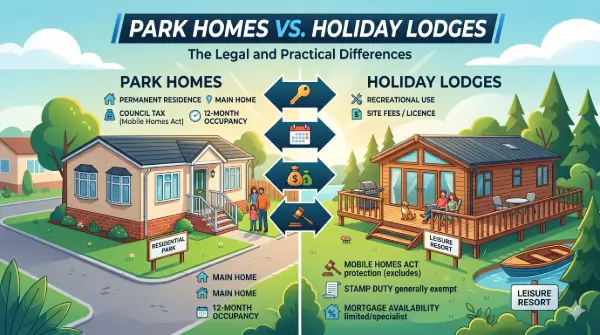
If you are currently searching for a new home, you have likely come across beautiful, high-spec properties marketed as "residential-spec lodges" or "luxury static caravans." They look stunning, they feature full central heating, and they are often built to BS3632.
However, there is a recurring point of confusion for many buyers: Does a "Residential Specification" build actually make it a legal Park Home?
The short answer is no. A building standard and a legal tenure are two entirely different things. Here is how to distinguish between a holiday lodge and a true, permanent residential park home.
The BS3632 Myth
The term BS3632 is the industry standard for residential-specification mobile homes. It defines specific requirements for:
- Thermal insulation
- Ventilation
- Structural integrity
- Noise reduction
While a unit built to BS3632 is undeniably more comfortable for year-round use than an older-style holiday caravan, BS3632 is a manufacturing standard, not a legal designation. Just because a holiday lodge is built to the same thermal standards as a residential home does not grant you the legal right to use it as your main, permanent residence.
The Real Difference: Legal Status
The defining characteristic of a "real" park home is not found in the insulation or the kitchen appliances—it is found in the land and the law. A true residential park home is governed by the Mobile Homes Act 1983 (and subsequent amendments).
1. Security of Tenure
A residential park home owner is protected by a "Written Statement" (your agreement) that grants security of tenure. This legal protection makes it very difficult for a site owner to remove you or change the terms of your residency without a legal process. Holiday lodges, conversely, are typically governed by holiday licence agreements, which can be terminated more easily or require you to vacate the premises for certain months of the year.
2. The Site Licence
The most important document you must ask for is the Site Licence:
- Residential Site: The licence permits permanent, year-round living as a main residence.
- Holiday Site: The licence restricts occupancy. You are typically required to prove that you have a permanent address elsewhere, and the site may enforce "closed" periods where you are not allowed to stay.
3. Council Tax
Residential park homes are banded for Council Tax because they are legally recognised as main dwellings. If you are looking at a lodge that the site operator claims is "tax-free" or "council tax exempt," that is a clear indicator that it is likely a holiday property, not a permanent residence.
Comparison at a Glance
| Feature | Residential Park Home | Holiday Lodge / Static |
|---|---|---|
| Primary Legislation | Mobile Homes Act 1983 | Holiday/Leisure Licensing |
| Legal Status | Permanent Main Residence | Secondary/Holiday Use |
| Council Tax | Payable (Banded) | Not Applicable |
| Security | High (Statutory Protection) | Dependent on Contract |
| Build Standard | Usually BS3632 | Variable (often BS3632) |
How to Protect Yourself
Before putting down a deposit, always take these three steps:
- Ask for the Site Licence: Do not take a salesperson's word for it. Request to see the official site licence held by the local council. It will explicitly state whether the park is for "holiday use" or "residential use."
- Read the Written Statement: If the site operator cannot provide a Written Statement under the Mobile Homes Act, you are not buying a residential park home.
- Verify the Planning Permission: Ensure the land has full planning permission for residential use.
Join the Discussion
Licensing and site agreements can be complex. Have you ever encountered a site that claimed a lodge was "residential" when it wasn't? Or are you currently navigating the paperwork for a move?
Join the conversation on our community forum here to share your experiences and get advice from others who have been through the process.