
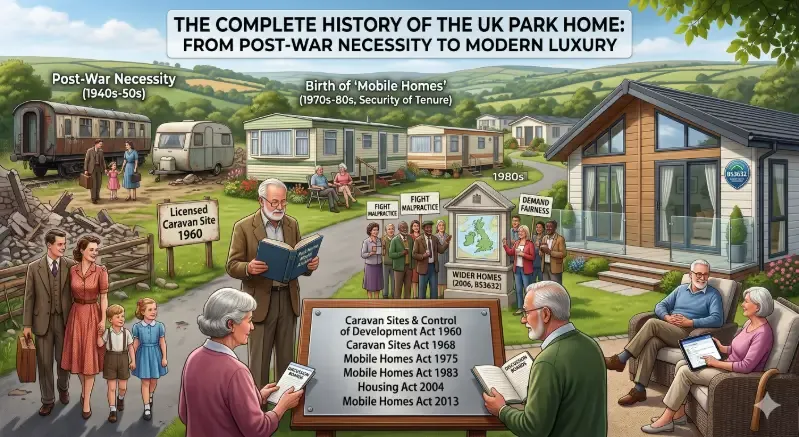
Today, residential park homes are synonymous with peaceful retirement, tight-knit communities, and a financially freeing release from the traditional property ladder. With an estimated 85,000 households living in mobile homes across more than 2,000 licensed sites in England alone, the sector is an essential pillar of the UK housing market.
However, the journey to the modern, energy-efficient lodges of today was not straightforward. It was born out of national crisis, and the legal battles fought over the decades have fundamentally shaped the rights, protections, and lifestyle that park home residents enjoy today.
The 1940s and 1950s: Born from the Blitz and the Housing Crisis
The story of the modern UK park home does not begin with luxury residential parks; it begins in the devastating aftermath of the Second World War. Following the Blitz, the UK faced an unprecedented housing shortage. Thousands of families had been bombed out of their bricks-and-mortar homes, resulting in a desperate, immediate need for temporary shelter.
During this era, anything with a roof and a chassis was repurposed. Families sought refuge in touring caravans, converted railway carriages, old buses, and decommissioned military vehicles. Seeing this mass migration from ruined cities to rural outskirts, opportunistic landowners—frequently farmers—began charging these displaced families a small ground rent to park their makeshift dwellings on agricultural land.
For nearly two decades, this way of life remained completely unregulated in the eyes of the law. Residents had absolutely no security of tenure, no statutory rights, and certainly no formal Written Statement outlining their legal standing. They were entirely at the mercy of the site owner and could be evicted with virtually no notice.
The 1960s: Taming the Wild West
The precarious nature of mobile living could not be ignored forever. In 1959, the government commissioned Sir Arton Wilson to investigate the growing phenomenon. His landmark report highlighted the chaotic lack of authority local councils held over these sprawling, informal caravan sites, which often lacked basic sanitation and infrastructure.
The government responded with the Caravan Sites and Control of Development Act 1960. This was a foundational piece of legislation. For the very first time, local authorities were granted the statutory power to require site owners to obtain a formal site licence before allowing land to be used for residential caravans. Crucially, this Act also established the first legal definition of a "caravan" based on its mobility and physical dimensions.
While the 1960 Act successfully controlled the land and improved site standards, it did little to protect the human beings living on it. Evictions were still rife. This imbalance necessitated the Caravan Sites Act 1968, which finally introduced basic human protections. It legally prevented site owners from evicting residents with residential contracts without first applying for a formal court order, ending the era of overnight, forcible removals.
The 1970s & 1980s: The Birth of the "Mobile Home"
As the 1970s arrived, the physical structures were changing drastically. Manufacturers moved away from thin-walled touring caravans towards twin-unit, prefabricated homes designed for permanent, year-round occupation. To see how drastically designs evolved during this era, you can explore our comprehensive Park Home Model Archive.
Recognising that these structures were no longer merely for holidays, Tom King MP introduced a Private Member's Bill that became the Mobile Homes Act 1975. This marked a semantic and legal turning point: legislation specifically used the term "Mobile Home" rather than "Caravan," reflecting the growing permanence of the lifestyle.
However, the true cornerstone of modern park home living—the legislation that still governs much of the sector today—arrived nearly a decade later. The Mobile Homes Act 1983 dramatically expanded the rights of residents. Most importantly, it granted genuine security of tenure to owners who rented their residential pitch.
The 1983 Act legally bound site owners to maintain the park's infrastructure, but it also controversially enshrined the site owner's statutory right to claim a commission on the sale of homes stationed on their land. This is the origin of the infamous "10% commission rule"—a topic that remains one of the most fiercely debated subjects on our Discussion Boards today.
The 1990s & 2000s: Fighting Malpractice and Expanding Dimensions
Despite the sweeping protections of the 1983 Act, the 1990s saw the sector plagued by a minority of rogue operators. Unscrupulous site owners frequently used intimidation tactics or arbitrary park rules to block residents from selling their homes on the open market, forcing them to sell back to the site owner at a fraction of the value.
In 1998, following intense lobbying by resident groups, the government formed the Park Homes Working Party. Their findings directly influenced the Housing Act 2004. This Act finally gave residents stronger legal footing to sell their homes on-site and explicitly changed the implied terms of pitch agreements so that the sheer age of a home could no longer be used as a weapon to block a sale.
Simultaneously, the homes themselves were becoming significantly more advanced, built to the stringent British Standard BS3632. Manufacturers were adding thicker, modern exterior insulation to improve energy efficiency. However, this extra cladding often pushed older homes slightly over the legal 20ft width limit set back in the 1960s. Following pressure from groups like the Independent Park Home Advisory Service (IPHAS), the government updated the legal dimension criteria in 2006, officially expanding the maximum permitted width to 6.8 metres (approximately 22.3ft) to accommodate modern residential standards.
2013 to Present: Power to the Residents
The most significant modern shake-up in recent history occurred with the Mobile Homes Act 2013, introduced by Peter Aldous MP.
This Act was designed with one primary goal: to stamp out persistent rogue practices once and for all. It fundamentally overhauled the buying and selling process, completely stripping site owners of their ability to unreasonably veto or interfere with open-market sales.
Furthermore, the 2013 Act introduced strict new legal frameworks governing annual pitch fee reviews, making the process highly transparent and tying increases strictly to inflation indices (RPI/CPI). It also granted local authorities the teeth they had been missing since 1960: the power to serve formal compliance notices on failing site owners and to charge licensing fees to fund proactive enforcement.
The Future of Park Home Living
From the desperate days of converted railway carriages on muddy fields to the highly regulated, energy-efficient, and community-focused lifestyle of the 2020s, the UK park home has undergone a remarkable evolution.
The history of the park home is, ultimately, a testament to the resilience of its residents. Every piece of protective legislation, every defined structural dimension, and every standardized pitch agreement exists because park homeowners organised, shared knowledge, and demanded fairness.
As you settle into your community today, you are part of a rich, uniquely British legacy—one that continues to be written by the members of a forum just like this one.
From Post-War Necessity to Modern Luxury: The Complete History of the UK Park Home
Today, residential park homes are synonymous with peaceful retirement, tight-knit communities, and a financially freeing release from the traditional property ladder. With an estimated 85,000 households living in mobile homes across more than 2,000 licensed sites in England alone, the sector is an essential pillar of the UK housing market.
However, the journey to the modern, energy-efficient lodges of today was not straightforward. It was born out of national crisis, and the legal battles fought over the decades have fundamentally shaped the rights, protections, and lifestyle that park home residents enjoy today.
The 1940s and 1950s: Born from the Blitz and the Housing Crisis
The story of the modern UK park home does not begin with luxury residential parks; it begins in the devastating aftermath of the Second World War. Following the Blitz, the UK faced an unprecedented housing shortage. Thousands of families had been bombed out of their bricks-and-mortar homes, resulting in a desperate, immediate need for temporary shelter.
During this era, anything with a roof and a chassis was repurposed. Families sought refuge in touring caravans, converted railway carriages, old buses, and decommissioned military vehicles. Seeing this mass migration from ruined cities to rural outskirts, opportunistic landowners—frequently farmers—began charging these displaced families a small ground rent to park their makeshift dwellings on agricultural land.
For nearly two decades, this way of life remained completely unregulated in the eyes of the law. Residents had absolutely no security of tenure, no statutory rights, and certainly no formal Written Statement outlining their legal standing. They were entirely at the mercy of the site owner and could be evicted with virtually no notice.
The 1960s: Taming the Wild West
The precarious nature of mobile living could not be ignored forever. In 1959, the government commissioned Sir Arton Wilson to investigate the growing phenomenon. His landmark report highlighted the chaotic lack of authority local councils held over these sprawling, informal caravan sites, which often lacked basic sanitation and infrastructure.
The government responded with the Caravan Sites and Control of Development Act 1960. This was a foundational piece of legislation. For the very first time, local authorities were granted the statutory power to require site owners to obtain a formal site licence before allowing land to be used for residential caravans. Crucially, this Act also established the first legal definition of a "caravan" based on its mobility and physical dimensions.
While the 1960 Act successfully controlled the land and improved site standards, it did little to protect the human beings living on it. Evictions were still rife. This imbalance necessitated the Caravan Sites Act 1968, which finally introduced basic human protections. It legally prevented site owners from evicting residents with residential contracts without first applying for a formal court order, ending the era of overnight, forcible removals.
The 1970s & 1980s: The Birth of the "Mobile Home"
As the 1970s arrived, the physical structures were changing drastically. Manufacturers moved away from thin-walled touring caravans towards twin-unit, prefabricated homes designed for permanent, year-round occupation. To see how drastically designs evolved during this era, you can explore our comprehensive Park Home Model Archive.
Recognising that these structures were no longer merely for holidays, Tom King MP introduced a Private Member's Bill that became the Mobile Homes Act 1975. This marked a semantic and legal turning point: legislation specifically used the term "Mobile Home" rather than "Caravan," reflecting the growing permanence of the lifestyle.
However, the true cornerstone of modern park home living—the legislation that still governs much of the sector today—arrived nearly a decade later. The Mobile Homes Act 1983 dramatically expanded the rights of residents. Most importantly, it granted genuine security of tenure to owners who rented their residential pitch.
The 1983 Act legally bound site owners to maintain the park's infrastructure, but it also controversially enshrined the site owner's statutory right to claim a commission on the sale of homes stationed on their land. This is the origin of the infamous "10% commission rule"—a topic that remains one of the most fiercely debated subjects on our Discussion Boards today.
The 1990s & 2000s: Fighting Malpractice and Expanding Dimensions
Despite the sweeping protections of the 1983 Act, the 1990s saw the sector plagued by a minority of rogue operators. Unscrupulous site owners frequently used intimidation tactics or arbitrary park rules to block residents from selling their homes on the open market, forcing them to sell back to the site owner at a fraction of the value.
In 1998, following intense lobbying by resident groups, the government formed the Park Homes Working Party. Their findings directly influenced the Housing Act 2004. This Act finally gave residents stronger legal footing to sell their homes on-site and explicitly changed the implied terms of pitch agreements so that the sheer age of a home could no longer be used as a weapon to block a sale.
Simultaneously, the homes themselves were becoming significantly more advanced, built to the stringent British Standard BS3632. Manufacturers were adding thicker, modern exterior insulation to improve energy efficiency. However, this extra cladding often pushed older homes slightly over the legal 20ft width limit set back in the 1960s. Following pressure from groups like the Independent Park Home Advisory Service (IPHAS), the government updated the legal dimension criteria in 2006, officially expanding the maximum permitted width to 6.8 metres (approximately 22.3ft) to accommodate modern residential standards.
2013 to Present: Power to the Residents
The most significant modern shake-up in recent history occurred with the Mobile Homes Act 2013, introduced by Peter Aldous MP.
This Act was designed with one primary goal: to stamp out persistent rogue practices once and for all. It fundamentally overhauled the buying and selling process, completely stripping site owners of their ability to unreasonably veto or interfere with open-market sales.
Furthermore, the 2013 Act introduced strict new legal frameworks governing annual pitch fee reviews, making the process highly transparent and tying increases strictly to inflation indices (RPI/CPI). It also granted local authorities the teeth they had been missing since 1960: the power to serve formal compliance notices on failing site owners and to charge licensing fees to fund proactive enforcement.
The Future of Park Home Living
From the desperate days of converted railway carriages on muddy fields to the highly regulated, energy-efficient, and community-focused lifestyle of the 2020s, the UK park home has undergone a remarkable evolution.
The history of the park home is, ultimately, a testament to the resilience of its residents. Every piece of protective legislation, every defined structural dimension, and every standardized pitch agreement exists because park homeowners organised, shared knowledge, and demanded fairness.
As you settle into your park home today, you are part of a rich, uniquely British legacy—one that continues to be written by the members of a community just like this one.