
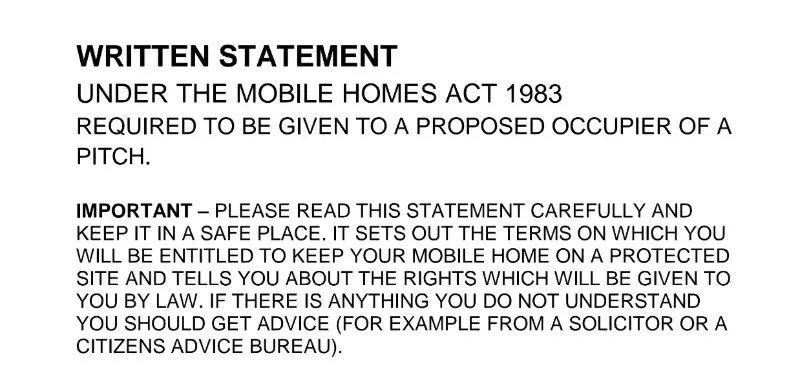
When you buy a residential park home, you own the physical building, but you lease the land it sits on. The legal contract that governs this unique relationship is called your Written Statement.
Under the Mobile Homes Act 1983, every residential park home owner is legally entitled to this document. It is your ultimate safeguard, outlining your rights, your responsibilities, and your absolute security of tenure. Without it, your legal standing is incredibly vulnerable.
⚠️ Crucial Legal Rule: By law, the park owner (or the seller, if you are buying a pre-owned home) must provide you with the Written Statement at least 28 days before you sign any contract or pay any money. This is to give you time to seek independent legal advice.
The Key Components of a Written Statement
While layouts may vary slightly between parks, a legally sound Written Statement is usually broken down into five distinct sections:
- Part 1: Information about Your Rights. This outlines your overarching statutory rights under the Mobile Homes Act, detailing your security of tenure, your right to sell the home on the open market, and your right to gift the home to a family member.
- Part 2: The Agreement. The specific contractual details. This includes the names of all parties involved, the exact address of the park, and your specific pitch number.
- Part 3: Implied Terms. These are standard terms that apply by law to all residential parks across the country. They cannot be altered by the park owner. They include your right to "quiet enjoyment" of the property and your legal duty to pay the agreed pitch fee.
- Part 4: Express Terms. These are the specific, tailor-made rules for your individual park. They cover everyday living conditions, such as:
- Age Restrictions: (e.g., "The park is exclusively for residents over 50").
- Pet Policy: (e.g., "A maximum of two dogs are permitted per pitch").
- Pitch Fee & Review Date: Exactly how much you pay, when it is due, and the specific month the annual CPI-linked review takes place.
- Parking: Clear rules on where residents and visitors are permitted to park.
- Subletting: This is almost universally forbidden on residential parks to protect the community atmosphere.
- Part 5: The Site Plan. A clear, scaled map or diagram showing the exact boundaries of your plot, dictating exactly where your rented land ends and communal land begins.
Understanding Site Rules
Your Written Statement will also encompass the official "Site Rules". These are deposited with the local council and dictate how the community operates. Common examples include:
- Maintenance: Residents hold a responsibility to keep their home and pitch in a clean, tidy, and safe condition.
- Alterations: Strict rules forbidding external alterations to the home, the addition of porches, or the erection of sheds without prior written permission from the site owner (largely to ensure fire safety spacing regulations are met).
- Utilities: Establishing that the site owner must maintain the main electricity, water, and sewerage infrastructure, while residents are responsible for paying for their individual usage.
📄 View a Model Written Statement
If you want to see exactly what this document should look like before you buy, you can download a formal, detailed example of the official Model Written Statement for England and Wales directly from our Legal & Resources hub in the Members Dashboard.